BCG Online Assessment 2026: Which Test Did You Receive?
Identify whether your BCG invitation is for the CCA, Casey online case, a numerical or cognitive test, Pymetrics, or the legacy Potential Test.
 BCG Online Assessment 2026
BCG does not run one identical online assessment everywhere. The test you receive depends on the office you applied to, the role, whether you are an Associate, intern, or MBA, and the recruiting cycle.
The practical question is always the same: which test did you receive, and where should you prepare?
This page helps you identify your assessment and sends you to the correct detailed guide.
BCG online assessment: quick answer
| Assessment | What it usually means | Detailed guide |
|---|---|---|
| BCG CCA | SHL screening assessment — reasoning, judgment, behavioral consistency | BCG CCA guide |
| Casey / OCE / HireQuotient | Chatbot-led online case — exhibits, calculations, final video | BCG Casey guide |
| Numerical / cognitive / logical test | Office-specific aptitude test | Numerical and cognitive test guide |
| Pymetrics / Harver | Legacy or office-specific games format | BCG Pymetrics guide |
| BCG Potential Test | Legacy timed case format | BCG Potential Test guide |
Why candidates get confused
BCG's online assessment varies by:
- office and country
- role (Associate, intern, MBA, experienced hire)
- recruiting channel and cycle
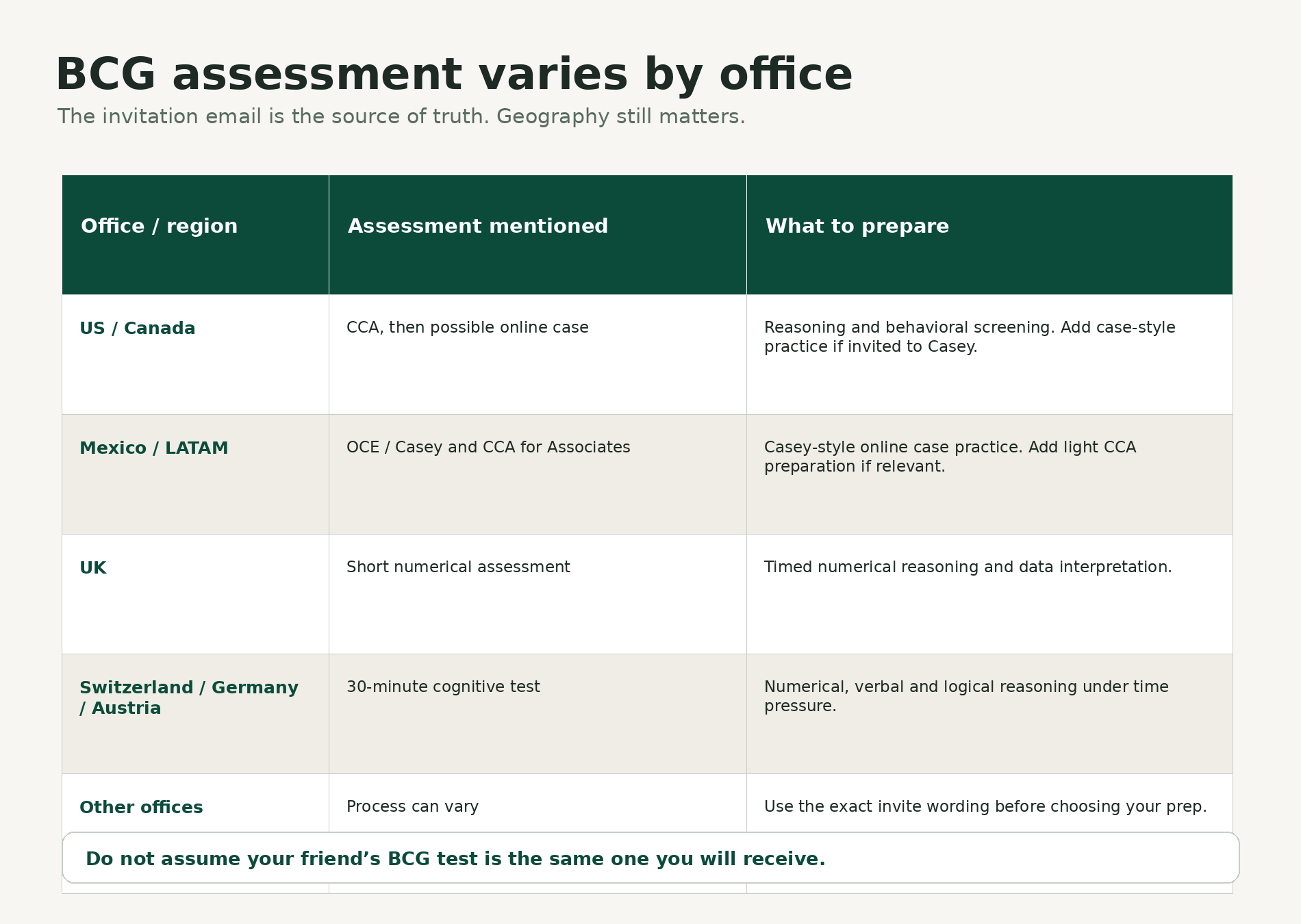
For example, BCG's US Associate process mentions the CCA and a potential later online case for selected candidates. BCG Mexico mentions the Online Case Experience and, for Associates, the CCA. BCG Switzerland and Germany/Austria describe a 30-minute cognitive test. BCG UK describes a short numerical assessment.
That is why candidate reports can look contradictory. They may all be true, but for different offices.
Which BCG test did you receive?
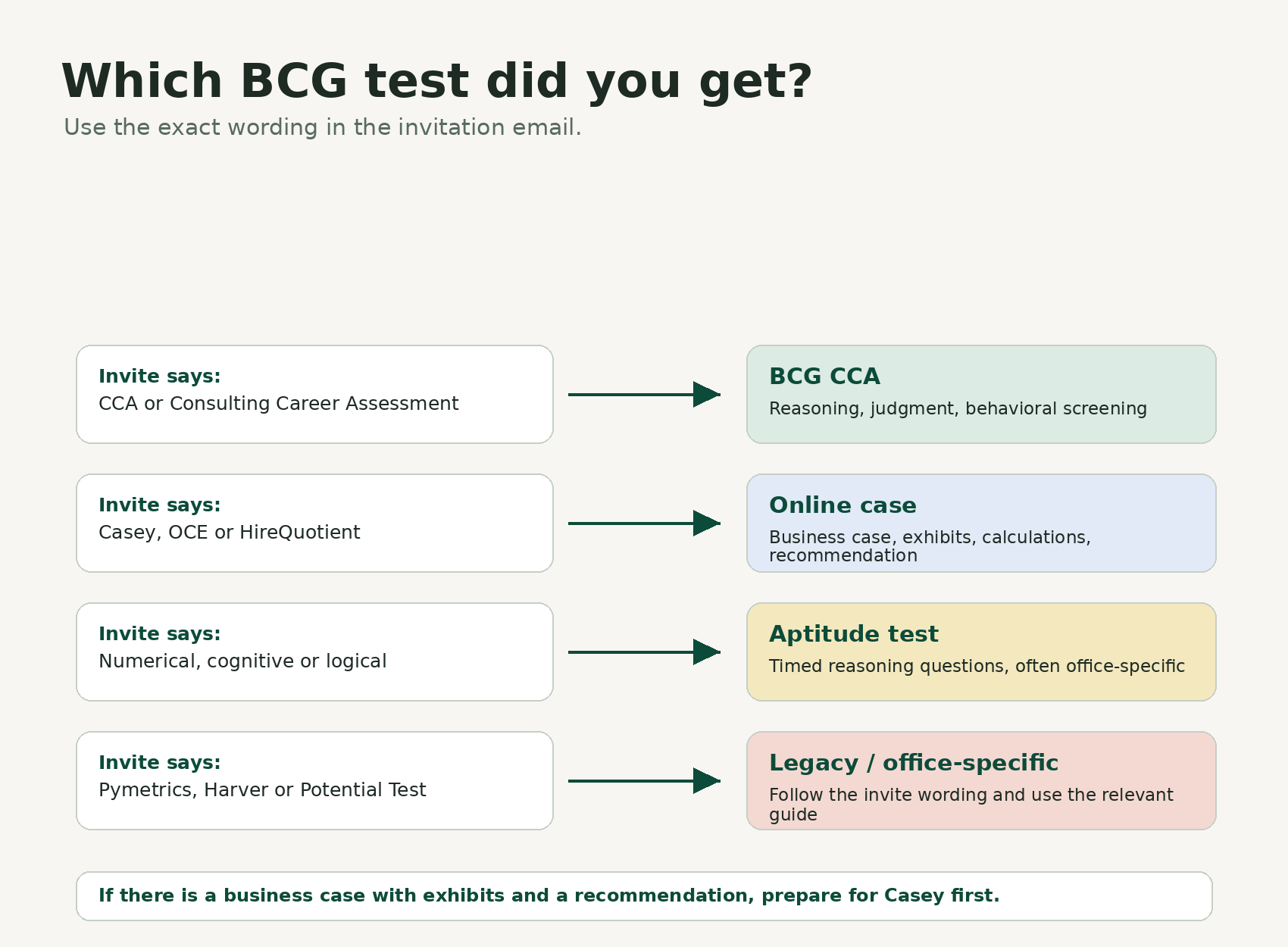
Start with the exact wording in your invitation email. The name in the email matters more than anything you read on Reddit or heard from another candidate.
 Which BCG test did you get?
If your invite says "CCA" or "Consulting Career Assessment"
You are likely taking BCG's Consulting Career Assessment. BCG describes the CCA as an assessment of cognitive functioning and behavioral traits, designed and administered by SHL. It is not a full business case. Read the BCG CCA guide for format, question types, and preparation.
If your invite says "Casey", "OCE", "Online Case Experience" or "HireQuotient"
You are likely taking BCG's online case assessment (Casey). Expect a business case in a chatbot-led format, with multiple-choice questions, exhibit interpretation, calculations, and a final video recommendation. Read the BCG Casey guide for format, timing, and how to prepare.
If your invite says "numerical", "cognitive", "logical reasoning" or "aptitude"
You are likely taking an office-specific aptitude test. These tests focus on numerical reasoning, verbal reasoning, logical reasoning, and chart interpretation under time pressure — without a full business case. Read the numerical and cognitive test guide.
If your invite says "Pymetrics", "Harver" or "Potential Test"
These are legacy or office-specific formats. See the BCG Pymetrics guide or BCG Potential Test guide if your invitation explicitly names them. Do not treat them as the default BCG process in 2026.
The three current assessment types
Most current BCG online assessments fall into three categories.
1. BCG CCA: the screening assessment
The CCA (Consulting Career Assessment) is BCG's SHL-based screening tool. BCG says it measures cognitive functioning and behavioral traits and helps them learn more about candidates beyond the resume. For US Associates, invitations are typically sent 30–90 minutes after application submission, candidates have 48 hours to complete it, and the assessment takes around 30–35 minutes. A calculator is permitted per BCG's CCA FAQ. The CCA cannot be retaken.
The CCA is not a case interview. Prepare with light numerical and logical reasoning, behavioral consistency, and workplace judgment. Read the full BCG CCA guide for question types, sample answers, and a prep plan.
2. BCG Casey: the online case assessment
Casey (also called the Online Case Experience, OCE, or HireQuotient online case) is BCG's chatbot-led business case. The case includes an introduction video, roughly 35 minutes to complete 8–10 questions — multiple choice, short answer, numeric input — and a one-minute video recommendation at the end. Answers are final and cannot be reviewed.
Casey is much closer to a live case interview than the CCA. Treat it seriously and prepare with timed case simulations. Read the full BCG Casey guide for format, question types, and how to prepare.
3. Office-specific numerical and cognitive tests
Some BCG offices use timed aptitude-style assessments. BCG Switzerland and Germany/Austria describe a 30-minute cognitive test covering numerical, verbal, and logical skills. BCG UK mentions a short numerical assessment. BCG Nordics mention a logical reasoning test.
These tests focus on speed and accuracy across reasoning question types — not case frameworks. Read the numerical and cognitive test guide for office-specific details and preparation.
BCG assessment by region
| Region / office | Assessment mentioned publicly | Recommended guide |
|---|---|---|
| US / Canada Associate | CCA, then possible online case for selected candidates | CCA guide first |
| Mexico Associate | OCE / Casey and CCA | Casey guide + CCA guide |
| UK | Short numerical assessment | Numerical / cognitive test guide |
| Switzerland | 30-minute cognitive test (numerical, verbal, logical) | Numerical / cognitive test guide |
| Germany / Austria | 30-minute cognitive test in first round | Numerical / cognitive test guide |
 BCG assessment varies by office
Do not assume your friend's BCG test is the same one you will get.
Legacy and office-specific formats
BCG Pymetrics / Harver
Pymetrics is a gamified psychometric assessment — a series of short online games that measure cognitive and emotional traits. BCG has used it in some offices and older processes. In 2026, most candidates should prioritise CCA, Casey, or office cognitive tests unless their invite explicitly says Pymetrics or Harver. Read the BCG Pymetrics guide if your invitation names it.
BCG Potential Test
The BCG Potential Test was BCG's older timed case-style screening assessment. Most BCG candidates in 2026 receive the CCA, Casey, or a cognitive test instead. Treat the Potential Test as a legacy format unless your invitation explicitly names it. Read the BCG Potential Test guide if your invitation names it.
Preparation routing
Once you know which test you have:
- CCA → BCG CCA guide — SHL format, question types, behavioral prep, sample answers
- Casey / OCE / HireQuotient → BCG Casey guide — chatbot case, exhibits, video recommendation prep
- Numerical / cognitive / logical → Numerical and cognitive test guide — office-specific format, question types, timing strategy
- Pymetrics / Harver → BCG Pymetrics guide
- Potential Test → BCG Potential Test guide
BCG online assessment FAQ
Is the BCG CCA the same as Casey?
No. The CCA is a screening assessment measuring cognitive functioning and behavioral traits. Casey is BCG's online case assessment — a full business case with exhibits, calculations, and a final recommendation. They require different preparation.
Does everyone get Casey?
No. It depends on the office, role, and recruiting process. Some candidates receive the CCA, some receive Casey, some receive a cognitive or numerical test. Some may receive more than one assessment across the process.
Is Casey considered a first-round interview?
In some processes, Casey works like an early case screen before live interviews. Whether BCG calls it an interview or an assessment, treat it seriously — poor performance can stop your process.
Can I use a calculator?
It depends on the test. BCG's CCA FAQ says candidates may use a calculator. The BCG online case guide mentions a calculator as part of the technical requirements for Casey. Some cognitive tests, such as the Switzerland format, must be completed without tools. Always follow the instructions in your own invitation.
Can I go back to previous questions?
For Casey, assume you cannot go back unless your instructions clearly say otherwise. The BCG online case guide says all submissions are final.
Will I know my score?
Usually no. The BCG online case guide says candidates do not receive their final score.
What happens after the BCG online assessment?
The next step is usually live case interviews or further screening. The exact sequence depends on your office and role.
Related detailed guides
- BCG Casey online case guide — chatbot case format, question types, video recommendation prep
- BCG CCA guide — SHL format, behavioral and reasoning questions, sample answers
- BCG numerical and cognitive test guide — office-specific aptitude tests, question types, timing
- Legacy BCG Pymetrics guide — Harver games, trait profiling, one-attempt rules
- Legacy BCG Potential Test guide — older timed case format, online and paper versions
Sources and update methodology
This guide draws on official BCG recruiting pages for specific offices (US, Mexico, UK, Switzerland, Germany/Austria, Nordics), BCG's published CCA FAQ, and the BCG online case preparation guide. Candidate-reported details are included where they add useful context and are clearly qualified as such.
This page is updated when BCG publishes changes to official recruiting pages or when the format of official descriptions changes materially. The last update was July 2026.