Green Transformation: Navigating EU Regulations
Case exhibits
2 exhibits for this case
ESG1EUreg
Identify the problem
The problem alredy presents itself with two main objectives: compliance with EU regulations and enhancement of market reputation. The candidate should first ask some clarifying questions.
Clarifying Questions
Regulatory Compliance:
- What specific EU regulations does the company need to comply with regarding environmental impact?
- Are there any deadlines for compliance with these regulations?
Current Environmental Impact:
- What are the primary sources of the company’s environmental footprint (e.g., emissions, waste, water usage)?
- Does the company currently have any environmental management systems in place (e.g., ISO 14001)?
Market Reputation:
- How does the company currently position itself in terms of sustainability in the market?
- What feedback has been received from customers, stakeholders, or the public regarding the company's environmental performance?
Operational Details:
- What are the main processes and operations of the company that contribute to its environmental footprint?
- What is the company’s budget for environmental initiatives?
Stakeholder Involvement:
- Who are the key stakeholders involved in the company's environmental strategy?
- What level of support and commitment is there from senior management for environmental initiatives?
Once the candidate has a better understanding of the prompt, they should move onto investigating the key KPIs they want to meet and what constraints they are.
If the candidate is unfamiliar with NPS, explain that it is a metric that measures customer satisfaction, obtained by surveying current customers. For an NPS > 0: More promoters than detractors, generally a good sign; NPS = 0: Equal number of promoters and detractors; NPS < 0: More detractors than promoters, indicating potential issues with the customer.
Frame the solution
The candidate should understand that this is mostly an optimization problem - i.e. one where we need to achieve 2 objectives while minimising cost.
Some points that could be mentioned are:
Segments for EU Obligations (E)
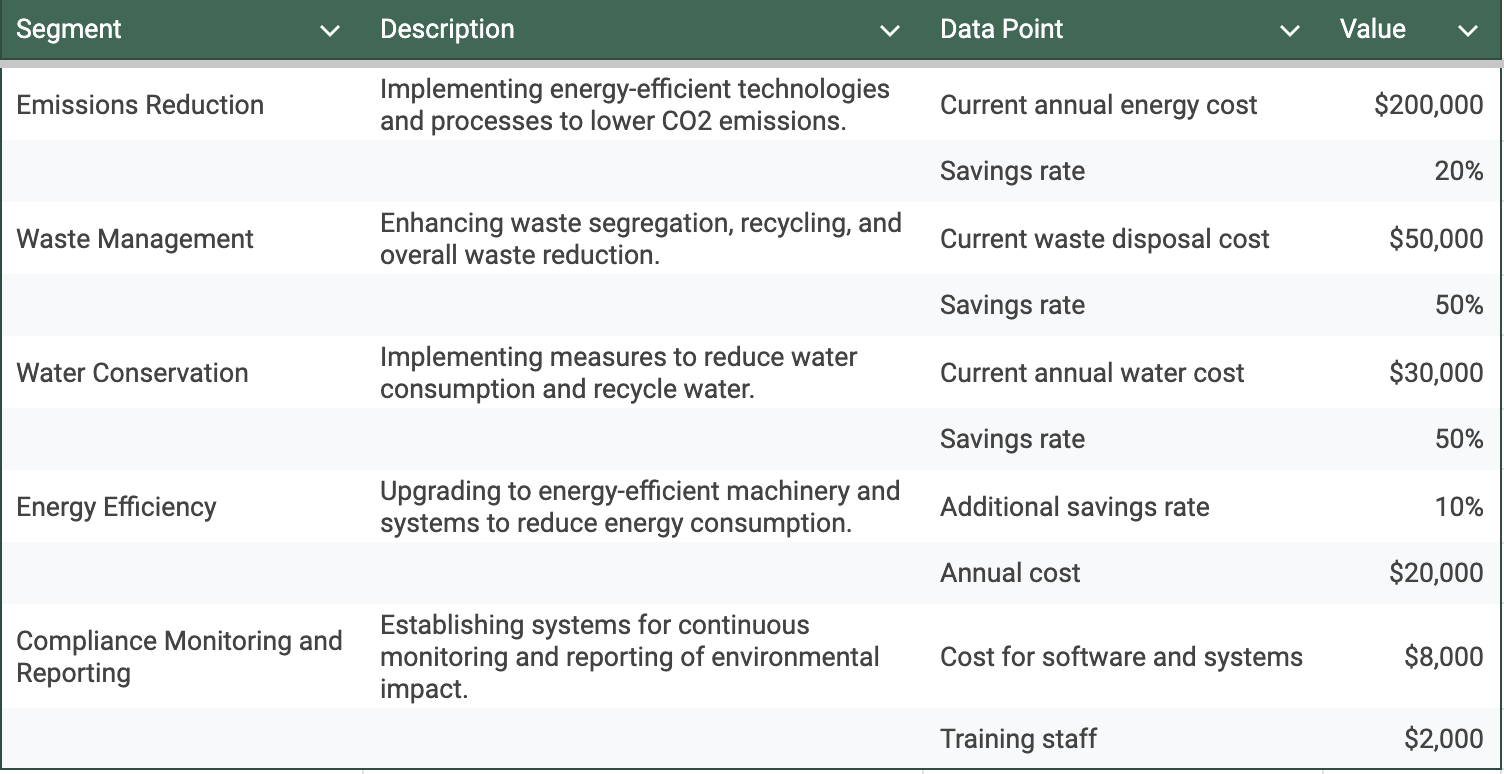
Emissions Reduction: Implementing energy-efficient technologies and processes to lower CO2 emissions. This could involve upgrading machinery, improving process efficiency, and using cleaner energy sources.
Waste Management: Enhancing waste segregation, recycling, and overall waste reduction. This involves developing more effective waste management systems to minimize landfill use.
Water Conservation: Implementing measures to reduce water consumption and recycle water within the production process. This helps in reducing the overall water footprint of the company.
Energy Efficiency: Upgrading to energy-efficient machinery and systems to reduce energy consumption and costs. This also helps in lowering the carbon footprint.
Compliance Monitoring and Reporting: Establishing systems for continuous monitoring and reporting of environmental impact to ensure compliance with EU regulations. This includes tracking emissions, waste, and resource usage.
Segments for NPS Improvement (N)
Customer Service Training: Conducting training programs for customer service teams to enhance the quality of customer interactions and resolve issues effectively.
Product Quality Enhancement: Investing in research and development (R&D) to improve product quality and reliability, leading to increased customer satisfaction.
Customer Feedback Systems: Implementing systems to collect, analyze, and act on customer feedback to improve products and services.
Loyalty Programs: Developing and promoting customer loyalty programs to increase customer satisfaction and retention by offering rewards and incentives.
Personalized Marketing Campaigns: Using data analytics to create personalized marketing campaigns that target different customer segments with relevant offers and communications.
Lead the Analysis
The candidate at this point should start enquire about data.
At this stage, the candidate should start calculating the total costs of implementation.
Segmenting Efforts for EU Obligations (E)
Emissions Reduction
- Activity: Implementing energy-efficient technologies and processes to reduce CO2 emissions.
- Calculation:
- Assume installing new energy-efficient machinery reduces annual energy costs by 20%.
- Current annual energy cost: $200,000
- Savings: $200,000 * 0.20 = $40,000
- Cost of implementation: Typically equal to one year's savings.
- Cost: $40,000
Waste Management
- Activity: Improving waste segregation, recycling, and reducing overall waste production.
- Calculation:
- Current waste disposal cost: $50,000/year
- By improving recycling, reduce waste disposal cost by 50%.
- Savings: $50,000 * 0.50 = $25,000
- Cost of new waste management system: Equal to annual savings.
- Cost: $25,000
Water Conservation
- Activity: Installing water-saving devices and recycling water used in production processes.
- Calculation:
- Current annual water cost: $30,000
- Savings from conservation efforts: 50% reduction.
- Savings: $30,000 * 0.50 = $15,000
- Cost of water-saving devices: Typically equal to one year's savings.
- Cost: $15,000
Energy Efficiency
- Activity: Upgrading to more energy-efficient machinery and systems.
- Calculation:
- Assume further upgrades reduce energy costs by an additional 10%.
- Additional savings: $200,000 * 0.10 = $20,000
- Cost of further upgrades: Typically equal to annual savings.
- Cost: $20,000
Compliance Monitoring and Reporting
- Activity: Setting up systems for continuous monitoring and reporting of environmental impact.
- Calculation:
- Cost for software and systems: $8,000
- Training staff: $2,000
- Cost: $10,000
Total Cost for EU Obligations (E): $40,000 + $25,000 + $15,000 + $20,000 + $10,000 = $110,000
Segmenting Efforts for NPS Improvement (N)
Customer Service Training
- Activity: Conducting training programs for customer service teams.
- Calculation:
- Training cost per employee: $500
- Number of employees: 30
- Cost: $500 * 30 = $15,000
Product Quality Enhancement
- Activity: Investing in R&D to improve product quality.
- Calculation:
- Assume cost of improving product quality through R&D projects.
- Typical mid-size project: $20,000
- Cost: $20,000
Customer Feedback Systems
- Activity: Implementing systems to collect, analyze, and act on customer feedback.
- Calculation:
- Cost of feedback software: $6,000/year
- Training and implementation: $4,000
- Cost: $10,000
Loyalty Programs
- Activity: Developing and promoting customer loyalty programs.
- Calculation:
- Cost of loyalty program software: $3,000
- Marketing and promotions: $2,000
- Cost: $5,000
Personalized Marketing Campaigns
- Activity: Using data analytics to create personalized marketing campaigns.
- Calculation:
- Cost of data analytics tools: $5,000
- Marketing execution: $5,000
- Cost: $10,000
Total Cost for NPS Improvement (N): $15,000 + $20,000 + $10,000 + $5,000 + $10,000 = $60,000
You can then further guide the candidate in the optimisation problem.
Synergy Adjustments:
The effective cost for NPS improvement is reduced by the synergy effect from spending on EU obligations.
Objective Function:
Constraints:
Solving the Problem:
Initial Costs Without Synergy:
- Total cost
Adjusting for Synergy:
- Synergy effect from :
- Effective requirement:
Therefore:
- Total cost
- Synergy effect from :
Checking Budget Constraint:
Recommendations:
The company can fulfill its EU obligations and improve its NPS while staying within the budget of $180,000. The optimal allocation of resources is to spend $100,000 on fulfilling EU obligations and $49,000 on improving the NPS, accounting for the synergistic effects.